
No products in the cart.
Development
The role of modern technology in supply chains

Supply chains have significantly improved through the application of modern technologies, which has noticeably and tangibly increased their efficiency. Examples of modern technology in this field are shown in the following figure:
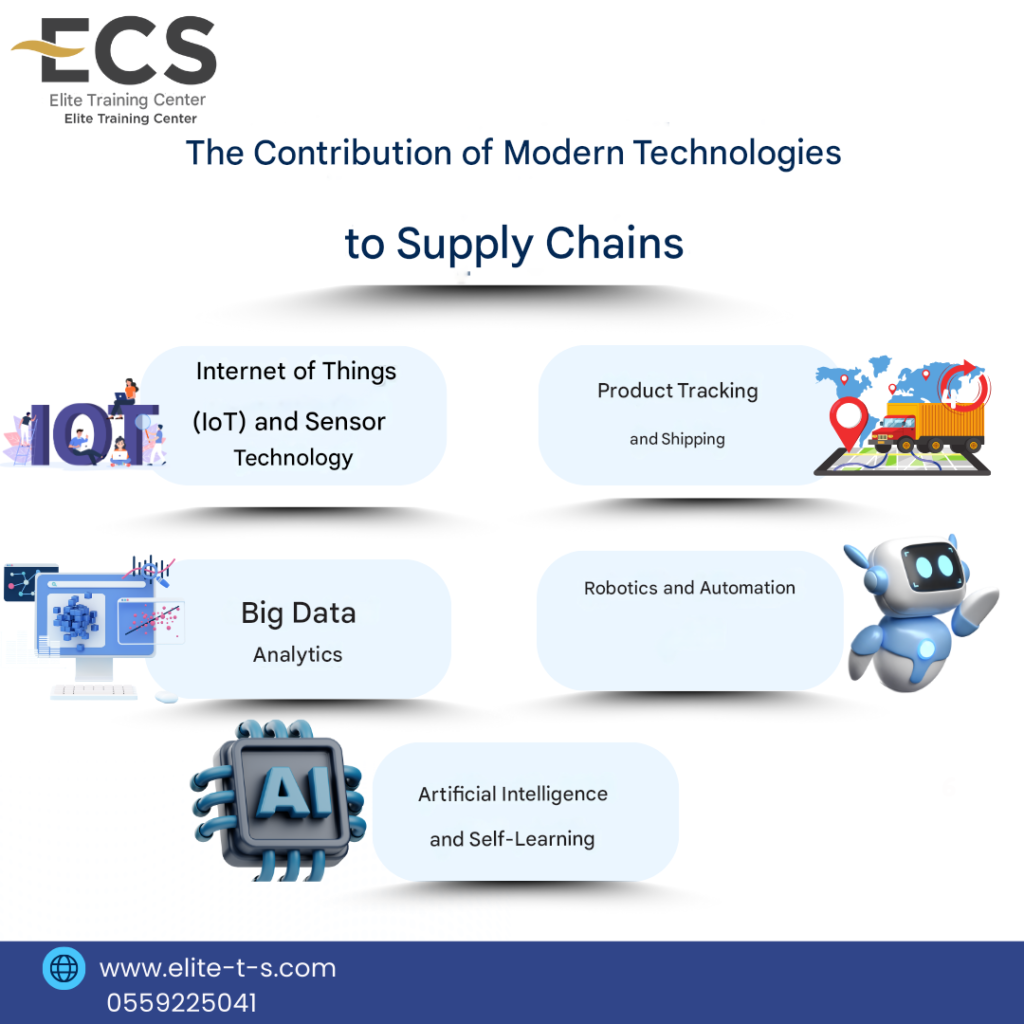
Where sensing technology is considered one of the powerful tools for improving supply chains. One of the most prominent applications of sensing technology is shipment tracking, where the location and condition of shipments are known in real time. GPS and RFID chips help identify delays and predict arrival times. This technology is also used in inventory management to monitor inventory levels in real time, which helps in production planning and timely replenishment. In addition, sensing technology is used to improve performance by sensing temperature, humidity, and vibration in various facilities. It also helps analyze the performance of logistics operations and identify opportunities for improvement. Sensing technology also contributes to the security and safety of facilities, as it is used to monitor the movement of people and assets in facilities and enhance employee safety and security. This technology also plays a major role in improving energy efficiency by sensing temperature and lighting to optimize consumption management, which leads to reducing various operating costs.
Big data analytics is also considered one of the influential technologies in supply chains, as it plays a major role in demand forecasting, for example, by analyzing historical demand data and the factors affecting it to build accurate predictive models that allow better planning of inventory and production. Big data analytics also plays a major role in improving planning and scheduling by analyzing production, shipping, resource, and other data that directly affect increasing efficiency and reducing delays. In addition, big data analytics plays a major role in analyzing event data and expected problems that directly affect the supply chain, which helps in forecasting and developing plans to mitigate or avoid them. It also increases opportunities to improve operational efficiency by reducing costs and increasing productivity through analyzing operational performance. It also has a major role in increasing visibility and transparency, which greatly helps in decision-making.
Artificial intelligence and machine learning also play a growing role in the technologies used in supply chains. Machine learning models are used in inventory and production planning, forecasting, and intelligent scheduling planning by using artificial intelligence algorithms to optimize supply chain operations while taking constraints and priorities into account, which increases efficiency. Artificial intelligence also works to predict risks and disruptions and increase opportunities for continuous improvement and increase efficiency and productivity in the long term.
Tracking and shipping technologies are also considered among the most prominent modern technologies used in supply chains, such as using location technologies like GPS and Bluetooth to track the location of products and shipments in real time, analyzing location data using artificial intelligence to discover patterns and identify potential problems, and using machine learning to analyze shipping data such as delays and missed routes.
Robots are considered among the most prominent modern technologies that are increasingly being adopted in supply chains. Robots and drones are used to track shipments and conduct inventory checks, and artificial intelligence is applied to plan the movement of these systems and coordinate their operations. Robots are also used in warehousing and handling goods to automatically load and unload goods from trucks and ships. Automated storage systems are developed using robots to manage inventory efficiently. Mobile robots are used to scan goods and trucks and update information in real time. Specialized robots are used to inspect transportation and storage infrastructure such as trucks and warehouses, which helps identify problems and carry out maintenance work more efficiently.
There are many companies that have succeeded in applying modern technologies in supply chains, including:
Amazon uses artificial intelligence systems to improve warehouse and distribution operations, demand forecasting, storage optimization, and determining the best shipping routes. It also uses computer vision technologies to automatically identify and assemble orders. Adopting modern technologies is considered a fundamental pillar of the success of Amazon’s logistics business model, as it has enabled the company to increase efficiency and improve customer experience on a global scale.
Coca-Cola Company:
Coca-Cola is also one of the leading companies in applying modern technologies in its supply chains. Coca-Cola uses artificial intelligence technologies to analyze sensor data in manufacturing and distribution facilities. This has helped the company forecast demand and improve production and shipping schedules, which increased supply chain efficiency. Coca-Cola’s ability to adopt advanced technologies in its supply chain is considered one of the main factors in its success as a global leader in the beverage industry.
Nike Company:
Nike has developed an artificial intelligence system to analyze sales and inventory data and forecast demand with high accuracy. This system has helped improve production and shipping plans, which reduced inventory costs and increased product availability.
Based on the above, empowering employees with modern technologies in supply chains and preparing the work environment to adopt this approach is the first practical step toward activating these technologies within organizations. Investing in training employees on the use of modern supply chain technologies is crucial to ensure the organization’s ability to compete and grow in this vital field.
From here emerges the necessity of advanced, professional, and globally developed training that keeps pace with modern changes. Advanced content delivered by experts from business organizations themselves enables trainees to access the latest scientific and practical trends that contribute to developing their work and achieving qualitative efficiency in their departments and specializations.
Elite Training adopts many advanced global training programs in the field of supply chains, procurement, and leadership development in the business environment, and seeks to provide its services to interested individuals with the highest quality and professionalism locally and globally.
For more information about our training programs, you can visit our website:
WWW.ELITE-T-S.COM
We are honored to communicate with you through the center’s numbers:
0559225041 – 138877746
References:
-
Khadr, S. M. (2022). Import Quality Management and Logistics Support. (p. 7).
-
Luo, Y., & Nambisan, S. (2022). The Global Company in the Digital Age. (p. 39).
-
Mohammed, L. M. (2023). Fields of Artificial Intelligence: Applications and Ethics. (p. 88).
-
Shipa. (2024, July 27). The Gradual Impact of Artificial Intelligence on Supply Chain Management.
-
Yousef, T. M. A. (2022). Blockchain Technology: Principles and Applications. (p. 298).
-
Various articles from The Wall Street Journal.