
No products in the cart.
Supply chain
Innovation and technology in supply chains

The use of technology in supply chains has become inevitable and essential in the modern era to improve the efficiency and effectiveness of supply chains and to increase business growth for companies and organizations seeking to keep pace with global developments in this field.
Effective use of technology is one of the key factors that enhances innovation within supply chain systems in companies. It involves challenging the status quo and thinking outside the box to drive progress and achieve results. Innovation is defined as “the process of introducing new ideas, methods, products, services, or solutions that have a significant positive impact and value. It involves transforming creative concepts into tangible outcomes that improve efficiency and effectiveness or address unmet needs” (2).
The effective and well-planned use of technology enhances innovation and diversifies solutions in supply chains, especially when technology is handled with precision and high skill to achieve objectives.
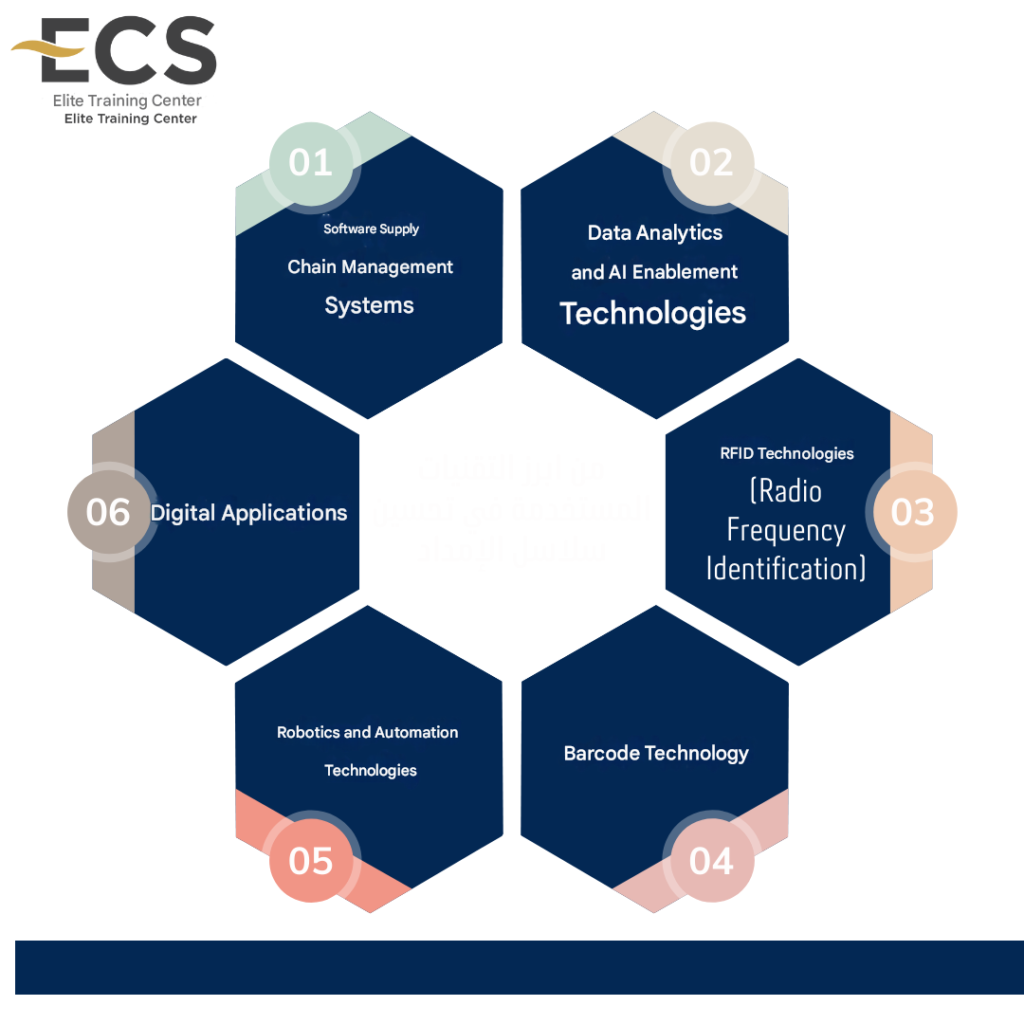
There are many technologies that can be activated in supply chains, including the following:
1- Shipment Tracking and Inventory Management Technologies:
Technology can be used to track the movement of products across supply chains. This includes the use of advanced Supply Chain Management (SCM) software and Global Positioning Systems (GPS) to track products and shipments in real time. Machine Learning and Artificial Intelligence can also be used to forecast future needs and manage inventory more effectively.
2- Communication and Collaboration Enhancement Technologies:
Technology can be used to improve communication and collaboration among all stakeholders in supply chains. Applications and digital platforms can facilitate information exchange and communication between suppliers, manufacturers, distributors, and customers. Online collaboration technologies, such as social networks, can also be used to enhance cooperation and interaction among parties.
3- Supply Chain Management Systems (SCM):
These are software systems and effective tools used to manage and coordinate supply chains.
4- Data Analytics:
By using various artificial intelligence technologies, companies can extract high-value insights through big data analysis, trend analysis, and forecasting, which increases opportunities to improve different supply chain operations.
5- RFID Technologies (Radio Frequency Identification):
This technology consists of small tags containing electronic chips that enable product tracking through appropriate sensors.
6- Barcode and Material Tracking Technologies:
These are used to track materials and products across supply chains using barcode codes. This technology helps provide comprehensive visibility of product movement and reduces human errors.
7- Robotics and Automation Technologies:
These are used in storage, material handling, and shipment operations, as well as in various processes across all stages of the supply chain, which increases overall efficiency.
8- Enterprise Resource Planning (ERP) Technology:
ERP systems are used to integrate and manage all supply chain operations of organizations and companies through a single platform. They include multiple functions such as planning, procurement management, inventory management, production management, and transportation management.
9- Transportation Management Systems (TMS):
These systems are used to plan and organize transportation operations and manage external supply chains. They include many features such as logistics planning, transportation recording, route planning, warehouse management, and shipment tracking.
10- Strategic Planning Techniques:
These are used for production planning, demand analysis, and sales forecasting, and include several methods such as statistical forecasting, business data analysis, and economic modeling.
There are many other technologies that are applied, and others that can be applied to supply chains. The close and interconnected relationship between technology and innovation is undeniable. Innovation can be achieved through technology in many different ways and methods, as technology provides the tools and techniques that can be used to improve and develop processes in new and different ways that achieve the expected progress and advancement.
Technology can be used in research and development processes to generate and test new ideas. It can also be used to improve productivity and efficiency through automation and the use of machines and robots to enhance operations, improve product quality, and provide a better customer experience.
In addition, technology can help enable innovation by providing the means and platforms that individuals and companies can use to exchange ideas, collaborate, and develop innovative solutions. For example, social networks and online collaboration platforms can be used to provide an interactive environment for innovation and collaboration among individuals and communities.
Technology also enables communication between industry experts and skilled professionals through various global memberships that allow members to access specialized platforms for exchanging expertise, information, and global experiences among experts and practitioners in the field, in order to achieve efficiency and quality in supply chain operations.
In general, integration between innovation and technology is a critical factor in the development of organizations. Innovation drives the use of advanced technology, and in turn, technology enables and contributes to the emergence of further innovations.
The role of training and mastering technical skills is also essential in achieving and activating innovation in different organizations. Professional certifications are considered one of the effective ways to empower individuals and employees with specialized global skills and technologies in the field of supply chains and procurement. Memberships with the awarding bodies of these professional certifications also enable trainees to communicate with experts from around the world to exchange ideas and effectively enhance innovation.
Elite Distinguished Training provides training for many specialized professional certifications in the field of supply chains and procurement, such as supply chain certifications from the British Institute of Supply Chain Management (IoSCM) in the fields of supply chains, procurement, warehousing, transportation, and logistics, in both Arabic and English. In addition, Elite Distinguished Training offers training for professional certifications from the Chartered Institute of Procurement & Supply (CIPS). Elite Distinguished Training is also a strategic partner of EIPM in Europe, providing specialized workshops in the field of procurement. Furthermore, Elite Distinguished Training offers services for registering individuals and organizations in memberships with these global institutes, which enable members to access platforms that include many features such as specialized research and articles, and the ability to communicate with industry experts from around the world.
References:
1- The Impact of the Internet and Technology on Supply Chains: Innovation and Digital Transformation, 17/9/2023, retrieved on 14/4/2024 from
https://www.mdd.sa/post/the-impact-of-the-internet-and-technology-on-supply-chains-innovation-and-digital-transformation
2- What Is Innovation? Definition, Types, Examples, and Process, Nick Jain, 15/5/2023, retrieved on 14/4/2024 from:
https://ideascale.com/ar/%D8%A7%D9%84%D9%85%D8%AF%D9%88%D9%86%D8%A9/%D9%85%D8%A7-%D9%87%D9%88-%D8%A7%D9%84%D8%A7%D8%A8%D8%AA%D9%83%D8%A7%D8%B1/
3- Supply Chain Management, Global Humanitarian Pivot for Development and Research Team, 23/ /2023, retrieved on 14/4/2024 from:
https://humanitarianpivot.org/?view=article&id=22:supply-chain-management&catid=10