
No products in the cart.
Supply chain
Management skills in supply chains and their impact on sustainable development

Achieving Operational Efficiency:
Management and managerial skills help achieve efficiency in supply chains by organizing and optimizing processes. The effective use of managerial skills in planning and organizing the flow of materials, information, and logistics operations leads to reduced costs, increased productivity, and improved quality of products and services.
Enhancing Collaboration and Coordination:
Managerial skills contribute to enhancing collaboration and coordination among different departments within the supply chain. These skills include effective communication, conflict management, and building relationships between teams and business partners. By improving communication and coordination, information flow and cooperation among stakeholders are strengthened, leading to better supply chain responsiveness and high performance.
Risk Management:
Management and managerial skills assist in analyzing and evaluating risks within supply chains and taking the necessary measures to address them. These skills include emergency planning, quality management, financial analysis, and strategic evaluation. By implementing risk management procedures, potential risks that could negatively impact supply chains—such as supply disruptions or cost increases—can be identified and mitigated.
Process Improvement:
Managerial skills are a powerful tool for improving processes within supply chains. These skills include total quality management, continuous improvement, and operations management. By applying quality management techniques and process analysis, obstacles can be identified, efficiency improved, and productivity increased across the supply chain.
Strategic Decision-Making:
Management and managerial skills play a critical role in making strategic decisions within supply chains. These skills include analytical ability, strategic planning, performance evaluation, and informed decision-making. By applying managerial skills to strategic decision-making, opportunities and challenges within supply chains can be identified, enabling sustainable growth and competitive advantage.
The above can be summarized in the following diagram:
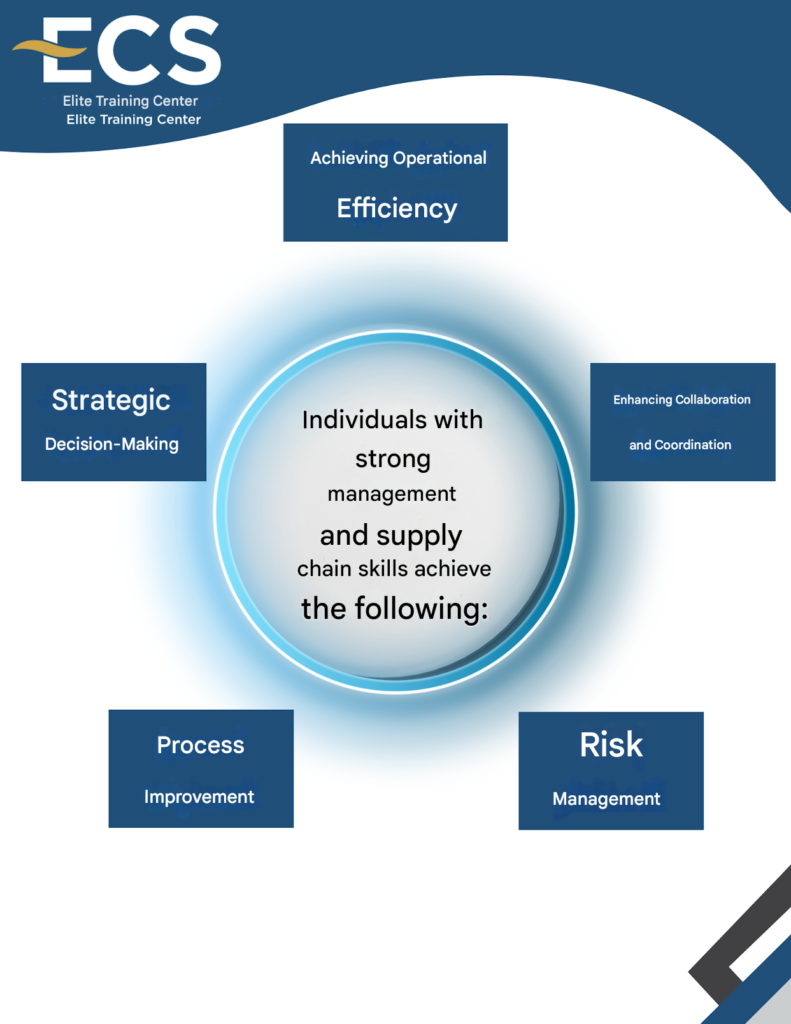
In general, it can be said that management and managerial skills play a vital role in improving the performance of supply chains. They help ensure a balanced flow of materials, information, and operations within the supply chain, enhance collaboration and coordination among different departments, assist in risk management and process improvement, and support strategic decision-making. Skilled managers can also make a significant contribution to achieving sustainable development in supply chains through the following:
Focus on Social Responsibility:
Management can adopt the principles of social responsibility and ensure their implementation in supply chains. It should collaborate with suppliers and business partners who uphold environmental protection standards, social justice, and workers’ rights. Management can establish common standards for sustainability and social responsibility in purchasing, sourcing, and manufacturing operations.
Environmental Planning and Sustainability:
Management should integrate environmental considerations into the planning, design, and operation of supply chains. This can be achieved by analyzing the environmental impact of activities, applying energy-saving techniques, reducing carbon emissions, and improving waste management. Management can promote sustainability by using resources efficiently and adopting environmentally sustainable practices.
Collaboration with Stakeholders:
Management must collaborate with various stakeholders, such as government institutions, non-governmental organizations, and local communities, to achieve sustainable development in supply chains. This collaboration can involve developing joint policies and standards, sharing information and expertise, and implementing sustainable development projects.
Innovation and Use of Technology:
Management can enhance sustainable development by encouraging innovation and using modern technology in supply chains. Technology can be applied to improve operational efficiency, reduce waste, enhance inventory management, and improve communication with suppliers and customers.
By adopting sustainable management practices and focusing on sustainable development, managerial skills in supply chains can make an important contribution to achieving sustainability. These efforts can help reduce negative environmental impacts and promote sustainable social and economic practices within supply chains.
Elite Training Solutions offers specialized training courses that enable trainees to acquire the appropriate managerial skills in the field of supply chains and procurement. This is achieved through short training programs, professional certifications in this field, workshops, and designing training programs according to the specific needs of organizations.
For more information and to register for these training programs, you can contact us through:
Email: Info@elite-t-s.com
WhatsApp: 0551998801 – 0507210800